Showing posts with label saline valley. Show all posts

Saturday, January 2, 2010

Alaska Resident formerly of Saline Valley

Friends of the SALINE VALLEY SALT TRAM
www.SaltTram.blogspot.com   SalineValleySaltTram@gmail.com
Salt Tram history is rapidly disappearing, and we are striving to rediscover the efforts of our forefathers in order to give proper recognition to their hopes, dreams and abundant sweat from an era that is rapidly fading from our memories. We are actively seeking out information about the mining of Salt in Saline Valley between 1903 and the 1950's, including: documents, photos, articles, stories, artifacts, etc. If you can help us out, please email us at the address above - Thank-you! --Tim and Brian Waag, the Waag brothers (aka E. Clampus Waagus).
Caution (PLEASE READ): Climbing around on the tramway is dangerous because its really old and defnitely unsafe, so don't even think about it. Shoot, just getting to it requires some perilous hiking, and if you don't believe me, just take a look at the Zig Zag Access Trail (or what's left of it). Plus, climbing on it weakens it and endangers your life. Also, the Saline Valley Salt Tram is on the National Register of Historic Places and should be treated with the respect that it deserves. What little remains is of great historic value, and should not be disturbed in any way. Heck, its probably against the law to move parts of the tram around, and certainly a crime to take home some of the few bits of it that remain (though you'd have to ask your friendly local BLM agent for details). So please treat it with the respect it deserves, so that future generations can enjoy whats left, without you messing it up. Really. Please. You can see its listing on the National Register of Historic Places at these web links:
National Register of Historic Places 1          National Register of Historic Places 2

*****************************************************************************************
 QUESTION1: It appears that salt was "mined" from the Salt Lake of Saline Valley into the 1950's. However, from the time the Salt Tram ceased operation around 1930, a significant amount of equipment and building material has been hauled away from the Salt Tram, starting with the loading station at the Salt Lake, to the 13.5 mile tramway that rises up to the crest of the Inyos, and back down the other side, to the Discharge Station at the former shores of Owens Lake. We are looking for photos that document the "carting off" of the Salt Tram over the decades, in order to document the disappearance of these materials over time. Please help - thank you.

*****************************************************************************************
Somebody found me through this website. Somebody who has some special knowledge of the Salt Tram. Somebody that currently lives in Alaska, but lived in Saline Valley in the 1960's as a teenager. This Somebody explored the Saline Valley side of the Salt Tram, and we hope to find out more about what was left of the Salt Tram in the 1960s.


If you were a Salt Tram explorer in any era between the 1930s and the 1990s, we'd like to hear from you. Much has been hauled away from the Salt Tram and we'd like to have a rough idea of when that happened.


In the 1960's, they camped at CS 1 for a week in the winter, and set up housekeeping in the drive motor area, as it had a nice enclosure and shielded from the wind. Was pretty miserable for the week, and had to pack 90 pound coils of copper wire and/or armature bars down one day, and then come back up the next dy with supplies. Weighed only about 130 at the time.


The Loading Station (at the Salt Lake in Saline Valley) and the Discharge Station (near the ghost town of Swansea near the former shores of Owens Lake - now semi-dry) have almost completely disappeared.

More on this contact later.

Brian sez: "armature" bars are copper bars in the electric motor. They are what produce the magnetic field once power is applied.


*****************************************************************************************

Monday, December 7, 2009

Salt Collection Equipment in the Middle of Lake

Friends of the SALINE VALLEY SALT TRAM
www.SaltTram.blogspot.com   SalineValleySaltTram@gmail.com
Salt Tram history is rapidly disappearing, and we are striving to rediscover the efforts of our forefathers in order to give proper recognition to their hopes, dreams and abundant sweat from an era that is rapidly fading from our memories. We are actively seeking out information about the mining of Salt in Saline Valley between 1903 and the 1950's, including: documents, photos, articles, stories, artifacts, etc. If you can help us out, please email us at the address above - Thank-you! --Tim and Brian Waag, the Waag brothers (aka E. Clampus Waagus).
Caution (PLEASE READ): Climbing around on the tramway is dangerous because its really old and defnitely unsafe, so don't even think about it. Shoot, just getting to it requires some perilous hiking, and if you don't believe me, just take a look at the Zig Zag Access Trail (or what's left of it). Plus, climbing on it weakens it and endangers your life. Also, the Saline Valley Salt Tram is on the National Register of Historic Places and should be treated with the respect that it deserves. What little remains is of great historic value, and should not be disturbed in any way. Heck, its probably against the law to move parts of the tram around, and certainly a crime to take home some of the few bits of it that remain (though you'd have to ask your friendly local BLM agent for details). So please treat it with the respect it deserves, so that future generations can enjoy whats left, without you messing it up. Really. Please. You can see its listing on the National Register of Historic Places at these web links:
National Register of Historic Places 1          National Register of Historic Places 2

*****************************************************************************************
We recently scanned some newly found historical Salt tram photos, which have been very helpful in our research. The next 2 photos are very interesting. As soon as we saw them, we believe they matched the equipment that is found out in the middle of the Salt Lake today. Here they are:


We haven't analyzed this equipment in detail, although it definitely was used in the salt gathering process. The individual scoops are shown to be full of salt in the photos, and clearly the scoops dumped salt into the ore carts sitting on the ore cart tracks. We don't know what era this salt collection equipment came from, as there were at least 4 companies that ran 4 different salt mining operations, all of which used the tram at some point for transporting the salt in buckets over the lofty Inyo Mountains. There is also a monorail associated with this piece of equipment, though I do not have a photograph of it, but I know I have seen a photograph of it somewhere, and will have to track it down (I believe there is a photo of the monorail at the Eastern California Museum in Independence). In fact, you can BARELY see the monorail in the second photo, to the left of the person on the left side of the photo. Strangely, these two pieces of equipment seem almost identical, except that one is rather tall and high above the salt plain, and the other is low and almost touching the ground! Strange....

Here is the tall one as it sits today in the Saline Valley Salt lake, followed by the shorter one, and then both of them together!


I wonder if the monorail track is still out there somewhere, submerged under the lake? I decided to rummage around in some photos from 2007 that Brian and I took out at the lake and found these:


Obviously, they are the buckets from the Salt Collection System in the first 2 photos of this post! Cool. On that trip in 2007 when the photos were taken, Brian and I walked around different parts of the Salt Lake and took photos of every piece of junk that we found, hoping that some of them were related to the salt Tram. Victory! Now we have to figure out more about this equipment.


Finally, here is a photo of the taller of the 2 Salt Collection Systems, taken by Farmer Dean and provided to me by Alan, proving once again that taking pictures of any old piece of junk does sometimes pay off. Note that the photo was probably taken in the fall, when the Lake had dried up, and he could walk out to it. The taller Salt Collection System is pretty tall, so it is buried pretty far into the lake - maybe about 5 or 6 feet down into the Salt. Wonder how much of it has been corroded by the salt.

*****************************************************************************************

Brian, Alan and Greg at Saline Valley

Friends of the SALINE VALLEY SALT TRAM
www.SaltTram.blogspot.com   SalineValleySaltTram@gmail.com
Salt Tram history is rapidly disappearing, and we are striving to rediscover the efforts of our forefathers in order to give proper recognition to their hopes, dreams and abundant sweat from an era that is rapidly fading from our memories. We are actively seeking out information about the mining of Salt in Saline Valley between 1903 and the 1950's, including: documents, photos, articles, stories, artifacts, etc. If you can help us out, please email us at the address above - Thank-you! --Tim and Brian Waag, the Waag brothers (aka E. Clampus Waagus).
Caution (PLEASE READ): Climbing around on the tramway is dangerous because its really old and defnitely unsafe, so don't even think about it. Shoot, just getting to it requires some perilous hiking, and if you don't believe me, just take a look at the Zig Zag Access Trail (or what's left of it). Plus, climbing on it weakens it and endangers your life. Also, the Saline Valley Salt Tram is on the National Register of Historic Places and should be treated with the respect that it deserves. What little remains is of great historic value, and should not be disturbed in any way. Heck, its probably against the law to move parts of the tram around, and certainly a crime to take home some of the few bits of it that remain (though you'd have to ask your friendly local BLM agent for details). So please treat it with the respect it deserves, so that future generations can enjoy whats left, without you messing it up. Really. Please. You can see its listing on the National Register of Historic Places at these web links:
National Register of Historic Places 1          National Register of Historic Places 2

*****************************************************************************************
December, 2009: Brian, Greg and Alan recently spent a quick weekend out at Saline Valley doing Salt Tram Research. I couldn't go because of foot surgery on 12/3 that'll take about 2 months before fully healed and ready to hike. Initially, they were going to head up to the Summit Station at 8,600 feet, but BWebb's report of Inyo snow out his front window put an end to that idea. The alternative was to head out to Saline Valley to meet some objectives for our research, as follows:


OBJECTIVE (1) Examine Control Station 1 to determine exactly how it makes it's huge 33 degree change of direction, as we've never looked at it that closely, and its the only tram station that makes such a huge direction correction. Click on the topo map to see the location of direction change.

OBJECTIVE (2) Find the tent sites shown in our recently acquired photo of Control Station 1, apparently right after construction. Examine artifacts around the site to acquire more research documentation.

OBJECTIVE (3) See if he could hike out to the large structure out in the middle of the lake, that is known to be high and dry during the fall, but surrounded by lake water the rest of the time.


Here's how they did:

Let's explain a few photos, vis-a-vis the 3 stated objectives (note that these were only the MAIN objectives - they had plenty of other stuff to research as well).

RESEARCH RESULTS (1) I've included a Topo Map showing the change of direction station, determined by looking at the dashed line route of the Salt Tram. Note that the map also incudes 2 colored lines identifying the location of the 2 sections of the tramway where the buckets are highest off the ground. Despite what has been published, the highest they get off the ground is about 700 feet, not 1,000 feet (which was probably just an estimate). As expected, the change of direction is accomplished by a bending of the overhead rails on which the carrier hangers run through the station. Brian took photos of this part of the construction that I will get in the mail from him later.


RESEARCH RESULTS (2) The side-by-side comparison of the area to the South of Control Station 1 (the Change of Direction Station) shows 9 tent cabins and 1 wood cabin in the historical photo. The modern photo was taken last weekend by Brian. Please click on it to show the full detail. Brian and gang were able to find all of the tent cabin sites, and reviewed some of the artifacts and dump down the side of the hill (more of a cliff, actually). In fact, that leads us to the photo of Greg with his face in the business end of the outhouse from Control Station 1 (CS 1) - a great and unexpected find! However, the historical photo does NOT show a wooden outhouse anywhere that we can see, so we'll need to extrapolate up the hillside to search for the outhouse site. In addition, Brian and company found another tent cabin site on the other side of the ridge and out of the view of the historical photo. Brian reports that no artifacts whatsoever were found at the tent cabin sites. There are 2 potential reasons for this: 1) they were hauled away when the Salt Tram shut down for good, and 2) the nasty weather blew away any last remnats of the tent cabins, and seeing as (it is likely) that they were built without foundations, there was nothing to hold the lightweight wood and tent material to the site; I would, however, expect some heavier metal artifacts to remain at the tent cabin sites, but apparently, that has not been the case. One photo shows Greg standing at one of the rock walls of a Tent Cabin site (not sure which one).


RESEARCH RESULTS (3) There was a Salt Tram loading device used at some point during the Salt Tram collecting operations, and 2 of them are still out on the lake, though hard to get to. The photo show the taller of the 2 devices, obviously surrounded by water. At other times of the year, probably late summer and fall, you can walk out on the salt lake on solid salt right up to the device. Another blog post will deal with these metal Salt loading devices, along with its accompanying monorail (!).


Great work Brian, Greg and Alan!

*****************************************************************************************

Wednesday, October 14, 2009

Welcome to White Smith's Marvelous Salt Tram

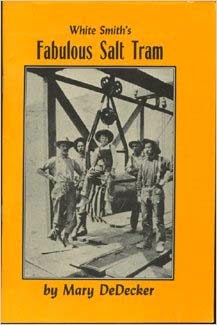
Above: This title "Welcome to White Smith's Marvelous Salt Tram" is a respectful rip-off of Mary DeDecker's Death Valley 49ers Keepsake booklet  No. 33 (44th Annual Death Valley '49ers Encampment, November 10 - 14, 1993) entitled "White Smith's Fabulous Salt Tram". Its a wonderful booklet, written by a wonderful person (whom I have never met, and she is no longer with us), and one of the first Salt Tram documents that we read, and helped to interest us in this "Fabulous" endeaver, the Saline Valley Salt Tram!
Above (please click to enlarge): Historical photo of the Salt Tram Summit Station (Motor Station Number 3) during a snowstorm. Photo Courtesy Eastern California Museum, Independence, Calif. It is one of my favorite photos of the Salt Tram, as it shows the powers of nature, and the difficult environment that the builders and the operators would face in operating in such a challenging environment.

Introducing the Waag Brothers - Tim and Brian: 
Longtime brothers Tim and Brian Waag have been adventurers and explorers since they were kids growing up together in Southern California. One of their first adventures involved getting lost at the Death Valley Sand Dunes at night (distances in the desert are farther than they appear!), when they attempted to cross them late in the day, and had their mother wandering along the highway 3 hours after dark, tears in her eyes, wondering if they would ever come out alive! Since then, they've rarely finished a hike with any daylight left in the skies, as the draw of desert exploration pulls them every deeper into the unknown.

It's difficult to write a short introduction to something like the Salt Tram, just as it is difficult to describe the attraction to something that on its face, is merely a mundane device for transporting salt that has long since passed its usefulness. Tramways used in mining operations hit their peak in the 1910's and the 1920's, so the Salt Tram represents the pinnacle of their technical development. Technically, the Salt Tram was of the "Double Rope Bleichert patent" design, and was designed and built by the Trenton Iron Company (Trenton, New Jersey), a wholly owned subsidiary of U. S. Steel.

Of course, tramways like the Salt Tram are still in use - only they are now only found at ski resorts! Yep - look closely, and you will see that ski lifts operate in the same general manner as the Salt Tram, so tram technology still lives on. However, it is a different story for mining operations. Where trams were once used, today they have been replaced with large earth moving trucks and / or conveyor belts. New mining tramways are no longer being built in the modern world, and the Slat Tram represents the last of its era.
Above (Click to Enlarge): Diagram of Salt Tramway over the Inyo Mountains; this diagram appeared in the May 1917 issue of the ASCE (American Society of Civil Engineers) document. It gives you an idea of the magnitude of achievement to build a tram that starts in Saline Valley and goes up and over the Inyo Mountains and into Owens Valley.

More than you want to know about the Waag Bros.: The boys grew up in El Segundo, next to LAX, where Brian found lifetime employment as an Electrician and later, as a Procurement Manager for Chevron. Tim headed up the road, to get a BS in Math and Computer Science at UCLA, followed by an MS in Management Science at USC. After 12 years of software development work at TRW, Tim and his family moved to San Luis Obispo in 1992 where they currently reside, and where Tim is an office manager for a law firm.

White Smith and the Salt Tram: The real story here, of course, is the every increasing pull of the Salt Tram itself. Saline Valley Salt Co. President White Smith served as a key player throughout the life of the Salt Tram. White Smith began mining Salt in Saline Valley in 1903, and hauling it out via North Pass in wagons. Later, when the Los Angeles Aqueduct required hydro-electric power in order to be built, the solution to the problem of how to transport Salt out of Saline Valley became obvious: build an electric-powered tramway!  Plans to build the tram were formulated beginning in 1910, the tram construction began in 1911, and on July 2, 1913, the first bucket of Salt came out of Saline Valley in a tram bucket! The stock market crash of 1929, along with a subsequent plunge in the price of Salt, and the tramway was operated for the last time. But it was built to last, and but for the vandalism and salvage that has occurred since, much of it should still be standing today.

Repeated visits to the Salt Tram emboldened the Waag Brothers to learn more, and in learning more, found that it has never been thoroughly investigated and documented for the wonderful, crazy idea from another time that it represents. They decided they were up to the challenge of drawing in as much as there is to know about the amped up ambition of local Bishop attorney White Smith, and his desire to build what is referred to as “White Smith's Fabulous Salt Tram”. 
Above (click to enlarge): Brian and Tim giving a presentation on the Salt Tram to the Historical Society of the Upper Mojave Desert, located in Ridgecrest, California. Brian at left with mic; Tim at right.

Presentations: The Waag brothers frequently give presentations on all aspects of the Saline Valley Salt Company tramway, as well as other topics where they have done extensive investigations (library and field). The presentation begins with the genesis of Tennessee-born White Smith's inspiration to build this truly one-of-a-kind Saline Valley salt mine and 13.5 mile tramway over the entire Inyo Mountains to Owens Valley and its railroad spur. Tim and Brian will then lead a guided pictorial tour of their hazardous 3 day trek along the entire Salt Tram route, starting in Owen's Valley and ending in Saline Valley. Finally, they will focus on the many mysteries that still confront them regarding the Salt Tram's construction, operation, bankruptcies, wild bucket rides, and ultimate demise.
Above (click to enlarge): Salt Tram worker "rides the line", a common occurrence. Photo Courtesy Eastern California Museum, Independence, Calif.

The Eastern California Museum (760) 878-0258 in Independence, California (in the remarkable Owens Valley) is currently seeking historical resource information about the Salt Tram, including but not limited to photos, artifacts, stories, and documents - if you have information that could assist with this effort to preserve the history of this magnificent monument to  the "can-do" attitude of the pioneers of Owens Valley, it would be most appreciated.

Salt Tram Updates: Consult this website http://salttram.blogspot.com for frequent updates on the progress of the Waag Bros. Saline Valley Salt Tram investigation. To become involved in the “Friends of the Saline Valley Salt Tram” group, please email us at SalineValleySaltTram@GMail.com. Thank-you.

************click to go to SALT TRAM HOME************