Thursday, February 15, 2018

5th Stock Certificate Acquired - Dated February 2, 1916

Friends of the SALT TRAM
www.facebook.com/SalineValleySaltTram
SalineValleySaltTram@gmail.com
www.SaltTram.blogspot.com 
**********
February 2, 1916: We are pleased to announce the acquisition of another Saline Valley Salt Co. stock certificate dated February 2, 1916, and issued to a "S. Bejack". This particular stock certificate is currently still in private ownership, but we were allowed to do a high resolution scan of it for our records.

First, take a look at the front and the back and get a good look at this piece of Salt Tram History (click to enlarge). I hope to do a deeper analysis of this stock certificate shortly.


Issued to "S. Bejack", Feb 2 1916: It was either "Bijack" or "Bejack". Initially, it seemed there was an ink "dotted I" above the 2nd letter "i", but alas, a search of ancestory dot com revealed that there are basically no "Bijack" surnames in the USA. However, there are many "Bejacks" and they are clustered in - wait - Tennessee (where most Salt Tram investors lived!). Bingo. Check this link: https://www.ancestry.com/name-origin?surname=bejack


Tuesday, April 21, 2015

"MALL" Washers Deciphered!

Friends of the Saline Valley SALT TRAM
**********
The Salt Tram's Ubiquitous "Malleable Iron" Washer: The Salt Tram was built using 650 tons of nuts and bolts, so it's not surprising that they standardized their parts as much as possible - none more so than the heretofore undeciphered "Malleable Iron" washer, as shown below (click on all photos to enlarge).
On a recent Salt Tram trip, we decided it was time to decipher the markings on this washer which we had seen everywhere and often. Why? Well, we were on the west side (Owens Valley) of the tramway on a recent trip. As on previous trips, we continue to discover nearby mines that clearly stripped the salt tram structures of wood beams and hardware to use in building their ventures. The massive salt tram beams were used to build head frames and shoring and houses and huts. The Salt Trams many bolts and washers were used to attach the "borrowed" wooden beams.

The above washer was photographed on a head frame in a wash near a mine on the westside of the salt tram. The MALL washer's markings were very clear, so I snapped a shot of it. The head frame is shown below (photo by Brian of Tim - our washer in the above photo is at Tim's right below):
However, claiming to be researchers, we need solid proof that much of the salt tram westside towers and stations were carted off and used in these mines. The most solid proof clearly is the unique washers that accompanied the stolen timbers. 

The salt tram used untold hundreds of thousands of these MALL washers, but in many of them, the markings are unreadable, often due to the large volume of corrosive salt nearby. On this particular trip, the markings on the head frames MALL washer were clearly visible. Now it was time to decipher them. Thanks to Brian and Tom, it has been done!


I think Brian got it right ("malleable iron"). Here is an example of the marking “Mall” still in use today.

Tom has always known these as mall washers, and the “MALL” stands for malleable iron. 

MALL ¾ 10
“MALL” for mall or malleable iron washer.
“¾” for the size of the hole for the bolt
“10” probably refers to the yield strength of these “malleable iron” washers. 10 KSI was probably the norm for this form of ductile iron at the turn of the last century. I do not think they are made of iron anymore, but rather some form of cast carbon steel, which has a yield closer to 30 KSI, hence the “30” you see on most of the newer versions of these. 

PAT MAY 10-04
The original patent is US759599, which was published May 10, 1904 to Charles G Ette.

A few choice quotes from the above patent:

This invention relates to improvements in washers, and more particularly to washers commonly employed in connection with tierods and the like used for withstanding heavy strains, such as in bridge construction, roof construction, &c.

One object is to provide a washer which can be cheaply manufactured, is light, is very strong, and is capable of being made as a malleable casting.


The present washer can be produced and sold more cheaply than can the old washer just above described, is thinner and lighter than is the old washer, and can be produced of malleable iron, thus being stronger than the old, heavier, and thicker washer.


There are a bunch of patents on these washers issued to Mr. Ette. 

OCT 28-7
I think this must be part of the bigger string  “OCT 28-7 PAT MAY 10-04”. “OCT 28-7” was the manufacturing date - in this case, October 28, 1907. This may have been a convention to assure a unique part number.

Below are a random sampling of the MALL washers en situ at the Salt Tram. Next, we'll need to see if every washer was marked identically to this one, or were there different dates and hence, different batches of washer production in use on the salt tram.

Above 2 photos: MALL Washers used to build the temporary tram structures used to move building material for the Salt Tram between Saline Valley and Motor Control Station 1 (station 7) at 2,500 feet of elevation gain above the valley.
Above: Typical construction of a Salt Tram Station, using a plentiful supply of MALL washers.
Above: just think how many MALL washers were used in a single salt tram structure like Motor Control Station 1 above in Saline Valley. We estimate that this 280 foot long structure used approximately 2,500 to 3,500 sets of washers and bolts to construct! All the bolt holes were drilled by hand, and all the nets were wrenched on with hand tools - unbelievable!

Tuesday, December 9, 2014

4th (and oldest) Stock Certificate Acquired - Dated July 31, 1912

Friends of the SALT TRAM
www.facebook.com/SalineValleySaltTram
SalineValleySaltTram@gmail.com
www.SaltTram.blogspot.com 
**********
Update December 8, 2014: We are pleased to announce the acquisition of a Saline Valley Salt Co. stock certificate dated July 31, 1912, and issued to a "Miss Kyrus Freeman". Note that this stock certificate was sent to me to be donated to the Eastern California Museum (ECM). The donors declined to request payment for the historic document, but chose to donate it instead. It will be a welcome and worthwhile addition to the ECM Salt Tram collection - the largest in the world. Before we go any further, let's start form the beginning of this exciting acquisition, shall we?
Above (click to enlarge): I was so excited when I saw this package in the mail on 12/8/2014. I wanted to tear it open at the Post Office, but brought it home so that Sue and I could open it together. What a wonderful gift to California History from the donor!

I received an email below on December 3, 2014 (name disguised to protect the donor). 

Hi Mr. Waag,

(Hope this gets through to you--your "Contact Me" link didn't have your email address.)

Are you interested in having another Saline Valley Salt Company stock certificate?  My wife was going through some old family papers and found one dated July 31, 1917.  It was for 100 shares, signed by both the Smiths, and issued to Kyrus Freeman, who was the sister of my wife's great-grandmother.  And she was from--yep--Martin, Tennessee.  It is in considerably better condition than the one you have from 1914.  It appears to have browned quite a bit more than the one you have from 1920, but is still perfectly legible.

We're in the fortunate position of not needing the money like your seller from Georgia, so the certificate is yours to pass on to the Museum if you wish.  We'd be pleased to have two of your T-shirts if you still have them and you feel the contribution is worth that much.

Regards, and keep up the good work,

M.E., W., Connecticut

My answer, of course, was "h*ll yeah!" (okay, that was the short version of my email response). Note that M.E. made the understandable error of reading the date as July 31, 1917, when indeed, if you look carefully (especially on the date on the back), it is dated July 31, 1912 - making it the earliest dated stock certificate of the 4 that we have uncovered so far. This means it was purchased before the Salt Tram was completed and the first bucket of salt was transported over the Inyo Mountains on July 2, 1913. When we print another set of Waag Bros. Salt Tram T-shirts, we will gladly and gratefully send them a pair of them.


Above (click to enlarge): Here I am with the stock certificate in my hot little hands, standing in front of the replica miner's cabin in our backyard in San Luis Obispo.


Above (click to enlarge): And here it is - in very good shape! As noted many times over, most stock certificates of the day were folded in thirds, either for mailing purposes, or because they were stored in envelopes or custom-made stock holder sleeves. Either way, all 4 Salt Co. stock certificates share these horrible creases. It'd be fun to find one without them, but I doubt that'll every happen.


Above (click to enlarge): Here is the back side. It was never re-sold.

What's next? I will do an analysis of this stock certificate, as each one contains little details that add additional information to our knowledge of the history of the Saline Valley Salt Co. and all it's later incarnations.

In the meantime, a heartfelt thanks goes out to the donor, who lives in Connecticut. I will be asking for additional information about Miss Kyrus Freeman, the one who purchased the stock certificate. M.E. has indicated that she was the sister of his wife's great grandmother. It's always very exciting to hear the story of the life of those who happened to invest and lose all their money on this surrealistic mining adventure.
Above (click to enlarge): Along with sending the stock certificate in a carefully wrapped bubble-wrapped package, M.E. sent along the above note. We welcome his visit out to California and the Salt Tram any time he is out here. Happy Trails, my (new) friend. From Tim and Brian Waag, the Waag Bros.

Friday, April 25, 2014

Salt Tram Stuff You Can Buy: 1912 Report to Shareholders

Friends of the SALT TRAM
www.facebook.com/SalineValleySaltTram
SalineValleySaltTram@gmail.com
www.SaltTram.blogspot.com 
Now available to the public in its first printing since 1912, this:
"Report of J. A. Goodman (Eastern Director) to the Stockholders of the Saline Valley Salt Co., after his investigation in September 1912"  
is available for $10 including shipping. The Waag Bros. sell the book at their cost as a tribute to the second Salt Tram President, J. A. Goodman (who succeeded original President White Smith). Please email us at SalineValleySaltTram@gmail.com to order your book for $10 including shipping. Read about the acquisition of this report by clicking here. Click on images below to enlarge.
Above: This booklet is available for purchase at the Eastern California Museum located in Independence, California. Photo above shows the Display Version of this document in the museum bookstore (alongside "Riding the High Wire" by Robert Trennert - all above tramways of the old west).

Some information about this booklet: This 28-page report provides important historical context for the construction of White Smith’s Amazing Salt Tram. The tram is located in Inyo County, California, and transported salt from “Salt Lake” in Saline Valley, up and over the crest of the Inyo Mountains, and down into Owens Valley. The tram first started operations in July, 1913 (10 months after this report was issued) and operated off and on until 1932, but never managed to make a profit.

J. A. Goodman Report: Table of Contents
This document contains 9 text headings that are identified below, along with their page numbers. 
1. To Stockholder Addressed - page 5
2. Tramway - page 5
3. Work Accomplished On The Salt Field - page 6
4. Class of Men Working On The Tramway - page 11
5. Work In Office - page 12
6. Attended Board Meeting - page 12
7. Propositions To Sell The Entire Field - page 18
8. Other Thoughts For Consideration - page 23
9. Purchase of Stock - page 24

This booklet contains report text, along with 8 original photo reports. Also included in the report is commentary from the Waag Bros. regarding the meaning of this critical document.

When this report was issued in September of 1912, the completion of the Saline Valley Salt Co.’s grand and glorious Salt Tram was still 10 months away. As such, the Goodman report provides rare insight into the thinking of the Salt Co.’s management and promoters during this critical final construction phase. You will definitely want to read this report!

Above: One of 8 unique Salt Tram photos contained in the booklet - photo by J. A. Goodman. Click to enlarge.
Above: Back Cover of the booklet providing some commentary on this Report by the Waag Bros. click to enlarge.
Above: A page from the Diary of Salt Tram Builder Henry Clifton Patterson. The entry dated Saturday, September 28, 1912 reads as follows: "Started on Station #8. Earl (Cliff's brother) came back & White Smith with a bunch of Gazoboes came up from Saline". This entry confirms the visit of J. A. Goodman for purposes of generated this report. Diarist Cliff often referred to the Tennessee Investors by what can only be described as derogatory terms.

Order your September 1912 J. A. Goodman report now by emailing to 
SalineValleySaltTram@gmail.com
We will mail you the book, along with a return payment envelope - just send us the payment after you have received this rare Salt Tram Report booklet.
Above: Tim displays an article on A. A. Forbes in the Inyo Register (written by Jon Klusmire about the Waag Bros. research into pioneer photographer A. A. Forbes), while the J. A. Goodman Salt Tram Booklet is seen right above it. Click to enlarge.

Our thanks go out to Coreen Conner of Highland, California, for the donation of this unique, rare and informative booklet! It now resides where it should be: in the Eastern California Museum in Independence, California! Ms. Conner has been mailed a copy of this booklet as a measure of thanks for her contribution to our Salt Tram investigation.

Monday, March 10, 2014

Stuff You Can Buy: Salt Tram Diary!

Friends of the SALINE VALLEY SALT TRAM
www.facebook.com/SalineValleySaltTram
SalineValleySaltTram@gmail.com
www.SaltTram.blogspot.com 
******************************************************************************* QUESTION1: Where was Cliff when his diary stopped on June 16, 1912, and had no entries for 30 days until July 15, 1912? Did he just stop making entries for a whole month? Perhaps, the workers was furloughed for a month while further funding was procured, or perhaps more engineering needed to be done to speed up the building process? Perhaps they were waiting on additional materials to continue the building process? In any case, June and July are near ideal months for working up in the Inyo mountains, and after working pretty much every day, it was unlikely that White Smith and Co. would simply take a month off "just because", and also likely that Cliff would suddenly stop writing in his diary, when he was so consist both before and after that 30 day break from diary writing. I need to examine the Inyo Register to see if there are any clues in the paper as to what happened. Perhaps the most likely scenario is an entry on June 15, 1912 at the very bottom of the page that simply says "Got Sick".
Okay, mystery solved. On his return to work (and diary entries) on July 15, 1912, we find this entry:
Boy, you would think that I would be reading this thing more careful. Let's sum it up: On 7/15/1912, Cliff wrote that he "Got Sick" in the simple manner that was his way. He returned to writing in his diary, and apparently returned from his home in Bishop where he had been recovering from illness, as he "came from Bishop to Camp at Station 26" - end of mystery.

Now in its 5th Printing (coming with an update in October 2018), "The Diary of Henry Clifton Patterson", written by the "Friends of the Salt Tram" and the Waag Bros. (Tim and Brian Waag), is available for purchase. The Bros. sell the book at their cost as a tribute to Salt Tram Builder Henry "Cliff" Clifford Patterson. Please email us at SalineValleySaltTram@gmail.com to order your book. Typically, the cost is $35 plus $5 shipping. Click on images below to enlarge.
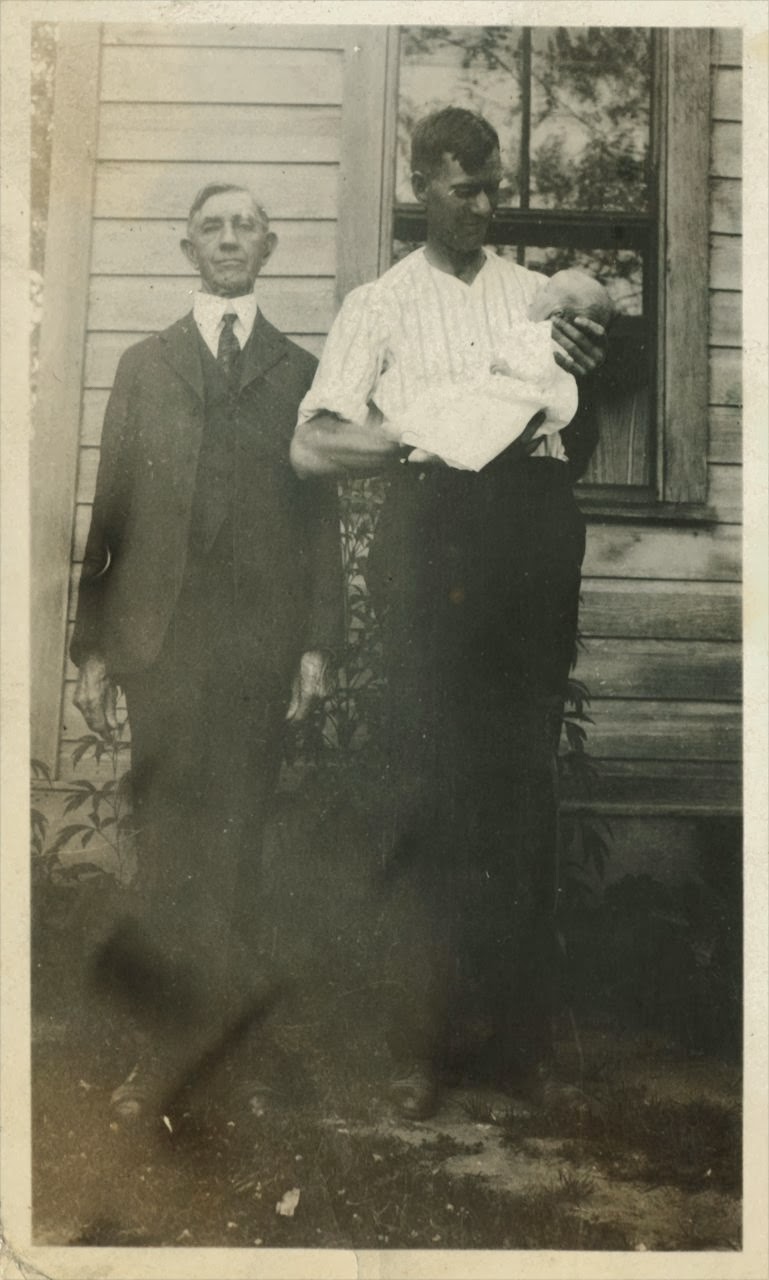
Above: Henry Clifton Patterson (center - tall - in white shirt) with infant son Fred Patterson, and Cliff's minister father S. S. Patterson (at far left). Photo courtesy Patterson Family.
Above: Tim (the older of the Waag Bros.) displaying the Salt Tram Diary book (text and photos of the Patterson Family).
Above: Tim displays the inside pages detailing the diary pages and historical photos - this photo at left is one of three "temporary tramways" that were built in order to build the Salt Tram! Wow!

This Coffee Table Quality book has the following features:
  • Full Color Dust Jacket including 4 photos
  • 52 full color Historical Photos, most courtesy of the Eastern California Museum
  • 146 clearly written Diary Pages spanning 2 years and 7 months (rarely a day missing!)
  • 7 Pages of Text explaining the diary's historical context
  • 4 Historical Articles that appeared in the Inyo Register between 1910-1922.
Above (left to right): Tim, Fred Clifton Patterson (age 85 - son of Salt Tram diarist Cliff Patterson), Brian.

The book itself contains the story of how Tim and Brian came across this amazing diary written by Cliff Patterson in a chance meeting with Cliff's son, Fred Patterson, who still lived in Bishop, Calif. until his passing in 2013. The book includes background information on Cliff Patterson and his service during World War I up through his passing. Cliff's diary also details a 3-week vacation he took by wagon into Yosemite in 1912, including how much he paid for hay and grain for his horses in Yosemite Valley. The diary discusses the difficulties of building the Salt Tram, and how Cliff's struggles while working alongside his brother Earl as they surmount daily obstacles including: avalanches, tents getting blown away, freezing weather, having to go duck hunt at Owens Lake for food and much more!

Below: a few random sample pages from this amazing window into history. Click to enlarge and see this amazing detail.


Order yours now by emailing to SalineValleySaltTram@gmail.com - we will mail you the book, along with a return payment envelope - just send us the payment after you have received this rare diary book.
Above: Brian shown above scanning the 3" x 5" diary pages in 2009 at the home of Cliff's son, Fred Patterson. The careful high resolution scanning of this rare and precious document at 1,200 dots-per-inch took almost 4 hours!

Monday, February 24, 2014

Other Trams: Mt Graham Lumber Tram

Friends of the SALINE VALLEY SALT TRAM
www.SaltTram.blogspot.com   SalineValleySaltTram@gmail.com

There is a small group of trams built around the Salt Tram era that were comparable in their audacity. The Mt. Graham Lumber Tram is one of them. Read about the Mt. Graham Lumber Tram of 1923 by clicking here.

The Mt. Graham Lumber Tram facts:

Construction
Year/Date Started:
Year/Date Completed:
Designed By:
Built by (Company):

Tramway Specifications
Tram Powered by: xxx
Length of Tramway:
Total Ascent: xxx
Total Descent: xxx

Saturday, February 22, 2014

Document 007 (Doc-007): Report to the Salt Co. Stockholders, Sept. 1912


Friends of the SALT TRAM
www.facebook.com/SalineValleySaltTram
SalineValleySaltTram@gmail.com
www.SaltTram.blogspot.com 
Document Title: Report of J. A. Goodman,  Eastern Director, to the Stockholders of the Saline Valley Salt Co., After His Investigation In September 1912 Illustrated. 28 page document (9 pages with text only, 8 pages with photo and caption only, 11 blank pages). Our copy is missing the back page (page 27 and 28), which we believe to blank, but we will never known unless another copy is unearthed. Most of the blank pages are blank because (with a few exceptions) they are located on the backside of a photo page which uses higher quality paper than the text pages.

By: J. A. Goodman, Eastern Director. Who is J. A. Goodman? Mr. Goodman played a prominent role in the management and promotion of the Salt Tram and is named in many documents. Here is what we know (by date):


Director: The June 23, 1911 edition of the Inyo Independent lists him as a "Director" of the Saline Valley Salt Co.


Eastern Director: This document (Doc-007) identifies him as the "Eastern Director" of the Saline Valley Salt Co. Sept. 1912.


President: The May 6, 1920 Saline Valley Salt Co. Stock Certificate, number 135, 250 shares, par value $1.00, issued to E. B. Houseal, signed by J. A. Goodman, President.

Document Photos: All 8 photos have photographer credits, as follows: 

• J. A. Goodman: 6 photos (author of the report document).
• W. H. Leffingwell: 1 photo. Leffingwell was the American Society of Civil Engineering - Chief Engineer in 1917, Chief Engineer of the Mono Power Company in 1911, Sales Agent for Saline Valley Salt in 1910. Date of Leffingwell's photo is unknown, but likely prior to Sept. 1912. Indicates the photo is of the Salt Fields 6 miles away from an elevation of 6,000 feet. This 6,000 foot elevation corresponds with the elevation of Control Station 2 - so we assume this is where he took his photo.
• "Constructing Engineer": 1 photo. Note that this is the exact same photo that we bought as a postcard on eBay that was attributed to A. A. Forbes. It has the classic white text annotation which was generally written onto the negative of the photo, but no A. A. Forbes name on it. This leads us to believe that this photo was NOT taken by A. A. Forbes. Note that it also identifies the photo as having been taken "last summer" (which would be Summer 1911), and that "work has now been completed" [on the section of the tram line shown in the photo].

Sample pages: I selected 2 random pages from this 28 page document. One sample below contains a representative random photo (8 of the 17 pages in the document are photos and captions only). The other is a representative random text page (9 of the 17 pages in the document are text only). The document itself is 4.75" wide by 6.25" tall. See sample pages below (click to enlarge).


Source: Out of nowhere (in February 2014), Ms. C. C. of California (identity not disclosed; name - email - address are in the Salt Tram investigation database) sent me an email indicating that she had this document, and oh, would be be interested in getting our hands on it? Uh - hell, yeah! She described it, and I was pretty sure that we had seen this one before. But what the heck! Sure, we'd love to have it. We told her we would we scan it, then donate it to the Eastern California Museum. Well, we've scanned it, and next time we are in Indie, we will make the donation in C. C.'s name to the Museum. Here's the email correspondence with Ms. C. C.:
On Feb 12, 2014, at 9:32 AM, C. C. wrote: Good Day, I have just found an old Stockholders Report of the Saline Valley Salt Co. by J.A. Goodman, Eatern Director after his investigation in September 1912.  It has some illustrations.  The booklet's cover is not in the best of shape but the contents and photos are still good.  I was going through some of my grandfather's things and found this.  I didn't see a stockholder's certificate to go with it but hope to in the future. Would you like to have this article?  
On Feb 12, 2014, at 11:12 AM, C. C. wrote: Do you have an address I can send this to?  I didn't see one on your web page. My grandfather did not own any stock at that time.  He was only 3 years old.  It could have been his father, Al Tallman, but I am not sure.  My brother has a lot of documents in Washington State but I won't be up there until June.  I will check for them at that time. ---C. C.
On Feb 14, 2014: Received envelope in the mail from C. C. with the note "I hope this helps you with your research". [Yes, C. C. it does!].
On Feb 20, 2014, at 4:04 PM, C. C. wrote: Hello Mr Waag, Thanks for the information.  I am glad it was of use to you.  I will be going to Washington in June and will try to find other similar information for you.  There isn't anyone left in the family that would have memory of my Grandfather. I hope to find more at my brother's place.          ---C. C.
Synopsis of Document: Report author J. A. Goodman was definitely a "Salt Tram Man", and obviously, the primary purpose of this document was propaganda on the part of Saline Valley Salt Co. Management. Clearly, the Salt Tram construction was WAY behind schedule at this point, and somebody had to be a cheerleader for the stockholders to convince them to keep their shares. Management of the Salt Co. had a vested interest in keeping stock prices high, as they were all heavily invested stockholders in the venture.

Despite the progagandist nature of the document, it does yield significant value as research material. We assume, unless proven otherwise, that Mr. Goodman did indeed visit the Salt Tram with other stockholders, and was accompanied by White Smith in Sept. 1912. We also assume that the photos attributed to Mr. Goodman were taken on this same trip. Since we are able to identify all the locations shown in the photos, this gives us a snapshot into the progress of the Salt Tram up to that date. In addition, there are other significant Salt Tram dates and statements of fact that were heretofore unknown to us, thus making this contemporaneous report a valuable research asset.


Just one example of the Propaganda!: Around April 1910, the Saline Valley Salt Co. ran ads in numerous Owens Valley newspapers inviting residents to invest in the Salt Tram. These extensive ads went on to indicate that the ENTIRE tramway would be complete and operational by October 1910! Fast forward almost 2 YEARS later (Sept. 1912) and it's still not done. Doc-007 optimistically states on page 6 that "in my judgment, it [the Salt Tram] will be in full operation on or about January 15, 1913. The Salt Tram transported its first bucket of Salt from the Salt Lake to the Discharge Station on July 2, 1913 - 168 days or almost 6 months later than J. A. Goodman's estimate of January 15. So at the time of this report, Goodman was estimating that the Salt Tram would begin operation in 4 months, but it was actually almost 10 months before the first bucket of Salt was transported - a HUGE discrepancy, and just one more in a series of missed deadlines for building the tramway and associated facilities. 

You can get your own personal copy of this Document: We are so impressed with the awesomeness of this 28-page document that we plan on printing it and making it available to our many Salt Tram followers. We plan to add explanatory annotations on all the blank pages of the document. We plan to sell it at our cost of $10 including shipping. At the same time, we plan on donating some of the copies to the Eastern California Museum so that they can sell them as a small fundraiser, which will generate some interest and funds for the "Friends of the Saline Valley Salt Tram" group. You can find out more about ordering this amazing document by clicking here.


Document Condition: This document arrived in "fair" condition, with a detached front cover, and missing page 27 and 28 (the back cover), which we believe to be blank. The internal pages are in good condition, though the 2 staple binding is rapidly failing.

Information Rating: Out of a scale of 1, 2, or 3, with 1 = the best information, 2 = marginal, and 3 = worthless or nearly so, Doc-007 is definitely a 1! Yeah!


Key Information: We have reviewed this document and have taken extensive notes regarding research questions, and what we have learned from it. We have added those notes to this booklet in the form of extensive annotations - you don't want to miss it!


***************click to go to Salt Tram Home***************